
Cognic Systems

GOVERNMENT & PUBLIC SECTOR

AI, Automation & Software Solutions for Government

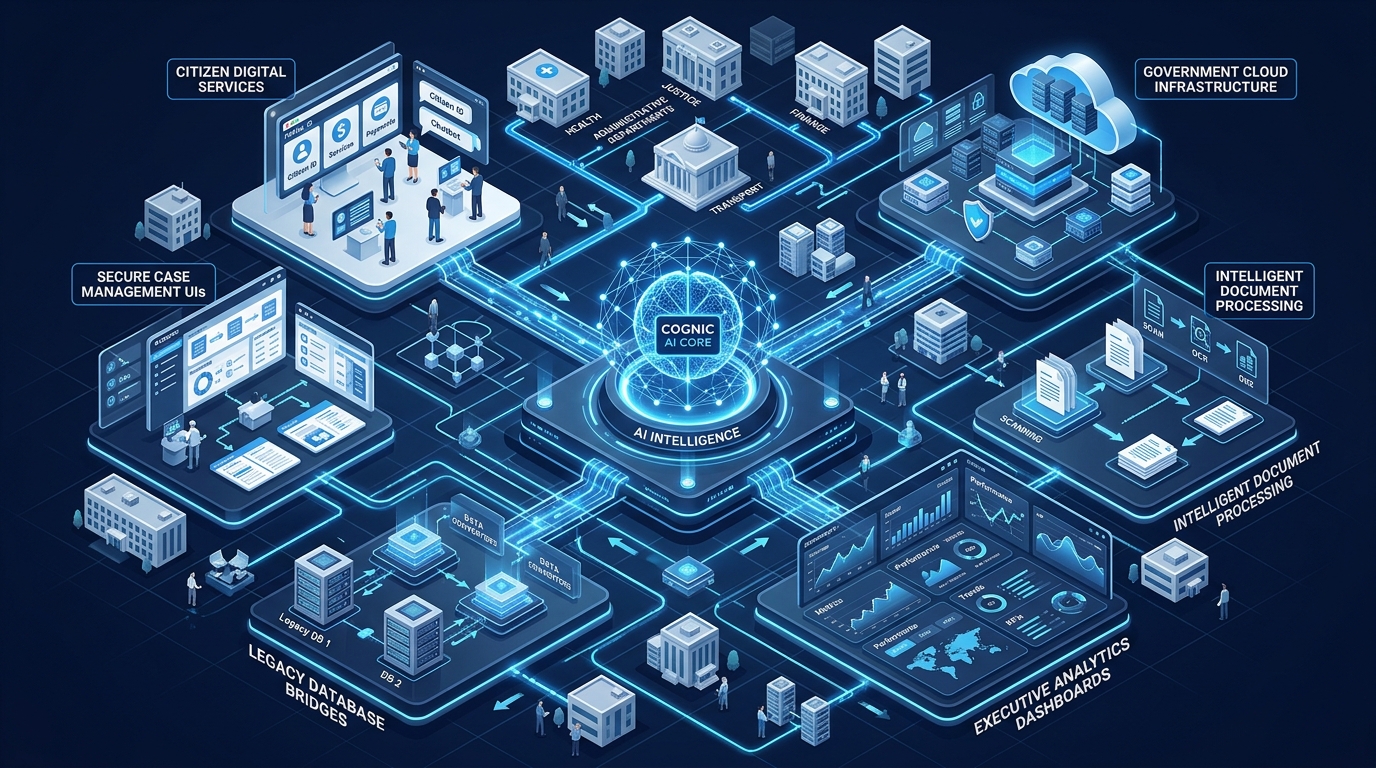
Cognic builds AI-powered software, workflow automation and connected data solutions that help public-sector organizations modernize operations, improve information access and streamline administrative workflows.
⚡
Agency Operations
��
Citizen Services
��
Document AI
��
Case Management
��
Legacy Modernization
Government & Public Sector Technology Ecosystem
PUBLIC SECTOR ENGINEERING PARTNER

Technology Built Around Public-Sector Operations

Government organizations manage complex workflows across departments, citizens, employees, documents, applications and data systems.

Many processes still depend on manual data entry, disconnected applications, documents, email and legacy technology.

Cognic engineers AI, automation, custom software and data solutions around these workflows to improve information flow, automate repetitive processes and connect existing systems.

��
Citizen Services
��
Administrative Workflows
��
Document Processing
��
Case Management
��️
Legacy Modernization
��
Data and Analytics
��
Reporting
��
Knowledge Management
OPERATIONAL BOTTLENECKS

Where Public-Sector Teams Lose Time and Visibility

Public sector agencies face key operational challenges in manual data management, legacy software integration, and document processing.

��
1. Manual Administrative Work

Employees spend time entering, validating and moving information between systems.

��️
2. Legacy Applications

Older applications and disconnected systems make modernization and integration difficult.

��
3. Document-Heavy Processes

Applications, forms, records, reports and supporting documents require significant manual processing.

��
4. Fragmented Information

Information is often distributed across departments, databases, applications and document repositories.

⏳
5. Slow Case Workflows

Approvals, reviews, routing and status updates often involve multiple manual steps.

��
6. Reporting Complexity

Teams need to consolidate information from multiple sources before producing operational and management reports.

PUBLIC SECTOR SOLUTIONS

Government Software Solutions Built Around Your Workflows

��
Government Custom Software

Build web, mobile and enterprise applications around specific public-sector workflows.

��
Government Workflow Automation

Automate repetitive administrative processes, approvals, notifications and system updates.

��️
Citizen Service Applications

Build digital applications that improve access to government information and services.

��
Case Management Solutions

Connect case information, documents, workflows, tasks and status tracking.

��
Document Processing Solutions

Extract, classify, validate and route information from government documents and forms.

��
Legacy Application Modernization

Modernize older applications while connecting them with newer systems and workflows.

��
Government Data & BI

Connect operational data to dashboards, reporting and decision-support workflows.

��
AI-Powered Government Applications

Add AI assistants, AI agents, RAG, Document AI and intelligent automation to public-sector applications.

AI IN PUBLIC SECTOR

Apply AI Where Public-Sector Work Needs Intelligence

AI becomes valuable in government when it is connected to approved information, defined workflows and appropriate access controls.

��
AI Knowledge Assistant

Help employees find policies, procedures, forms and approved internal information.

��️
Citizen Information Assistant

Provide access to approved public information through conversational interfaces.

��
Document Intelligence

Extract and classify information from applications, forms, reports and supporting documents.

��
Case Analysis Assistant

Help staff organize case information, retrieve relevant documents and prepare summaries for review.

⚙️
AI Operations Assistant

Help employees retrieve operational information, reports and procedures.

��
AI Agents for Government Workflows

Connect AI agents to approved tools and systems to support defined administrative workflows.

AUTOMATED WORKFLOWS

Automate Repetitive Public-Sector Workflows

Cognic combines AI, RPA, workflow automation and system integration to automate repetitive administrative processes while keeping defined approval and review steps under human control.

��
Application / Document / Request
→
⚡
Data & Document Processing
→
��
AI Understanding
→
��
Business Rules
→
⚙️
Workflow Automation
→
��️
Government Application / Database
→
��
Notification / Action
→
��
Human Review When Required
DOCUMENT PROCESSING

Turn Government Documents Into Structured Information

Public-sector organizations process large volumes of forms, applications, permits, and compliance records daily.

Applications
Forms
Invoices
Reports
Contracts
Permits
Licenses
Claims
Records
Correspondence
Supporting Documents
Compliance Documents
��
Document Received
→
��
OCR / Extraction
→
��️
Classification
→
✅
Validation
→
��
Business Rules
→
��
Human Review
→
⚙️
Workflow Automation
→
��️
Government System
→
��
Audit Trail
SYSTEM INTEGRATION

Connect the Systems Your Organization Already Uses

Cognic connects AI and automation with existing applications, databases and business systems rather than requiring organizations to replace every system.

��
Case Management
��
ERP
��
CRM
��
Document Management
��️
Databases
��
Accounting
��
HR Systems
��
Records Management
��
Citizen Service Applications
��
Reporting Systems
✉️
Email
☁️
Cloud Storage
��
APIs
��
Legacy Applications
1. Existing Systems
Case, ERP, CRM, Databases, Legacy
→
2. Integration Layer
Cognic Connectors & Secure APIs
→
3. AI + Automation
Document AI, RAG & RPA Engines
→
4. Business Workflow
Validation & Business Rules
→
5. Action / Update
Updates, Alerts & Notifications
DEPARTMENTAL IMPACT

AI & Automation Across Government Workflows

CITIZEN SERVICES
  • Information access
  • Digital applications
  • Request handling
  • Notifications
  • Service workflows
  • Citizen support
ADMINISTRATION
  • Data entry
  • Approvals
  • Document processing
  • Employee workflows
  • Email automation
  • Reporting
CASE MANAGEMENT
  • Case intake
  • Document organization
  • Case summaries
  • Task management
  • Status tracking
  • Workflow routing
FINANCE & OPERATIONS
  • Invoice processing
  • Purchase workflows
  • Financial reporting
  • Data reconciliation
  • Approvals
  • Operational analytics
RECORDS & INFO
  • Document classification
  • Information retrieval
  • Knowledge management
  • Records processing
  • Policy search
  • Report generation
OPERATIONAL ANALYTICS

Turn Public-Sector Data Into Operational Intelligence

Cognic connects data from applications, databases and operational systems to create dashboards, reports and analytics for government teams.

��
Program Performance
��
Case Volumes
��
Service Requests
⚡
Operational KPIs
��
Financial Data
��
Department Performance
⚙️
Workload
⏳
Processing Times
��
Application Status
��
Resource Utilization
⚠️
Exception Monitoring
��
Management Reporting
GOVERNMENT AI AGENTS

AI Agents That Support Public-Sector Teams

��
User / Approved Event
→
��
AI Agent
→
��
Understand Request
→
��
Retrieve Approved Info
→
��
Use Approved Tool / API
→
⚙️
Perform Defined Action
→
✅
Verify Result
→
��️
Human Approval When Required
"Find the policy for this process."
"Show applications awaiting review."
"Summarize this case file."
"Find the documents associated with this case."
"Prepare a report of pending requests."
"Create a follow-up task for this application."
"Show today's operational exceptions."
GROUNDED KNOWLEDGE

Connect Public-Sector Knowledge With Generative AI

Government organizations maintain policies, procedures, regulations, forms, reports, manuals and internal knowledge across multiple repositories. Cognic uses RAG to connect Generative AI with approved knowledge sources so employees receive responses grounded in authorized information.

��
Approved Government Docs
→
��
Document Intelligence
→
��️
Knowledge Store
→
��
RAG Engine
→
✨
Generative AI
→
��
Grounded Response
→
��
Source Reference
��
Policy Assistant
��
Employee Knowledge Assistant
��
Document Search
⚙️
Procedure Assistant
��
Case Document Retrieval
��
Report Analysis
HUMAN CONTROL

Keep People in Control of Important Government Workflows

Cognic designs automation with defined business rules, approval stages, confidence thresholds and human review for workflows that require human judgment.

⚙️
Automation
→
⚖️
Confidence / Business Rule
→
��
High Confidence → Continue
OR
��
Low Confidence → Human Review
→
✅
Approved Action
→
��️
System Update
SYSTEM ARCHITECTURE

A Connected Technology Architecture for Government

1. DATA SOURCES
Applications
Documents
Databases
Case Records
Forms
Reports
APIs
Legacy Systems
↓
2. DATA & INTEGRATION
APIs
Data Pipelines
Integration Layer
Document AI
↓
3. INTELLIGENCE
AI
Generative AI
RAG
AI Agents
Analytics
↓
4. AUTOMATION
RPA
Workflow Automation
Business Rules
↓
5. BUSINESS APPLICATIONS
Citizen Services
Case Management
Department Applications
Reporting
Custom Applications
↓
6. BUSINESS OUTCOMES
Connected Systems
Reduced Manual Work
Better Information Access
Faster Workflows
Improved Operational Visibility
OUR METHODOLOGY

How We Build Public-Sector Technology

01
Understand the Workflow

Map the process, users, systems, documents and business requirements.

02
Identify Automation Opportunities

Identify repetitive, manual and decision-support processes.

03
Assess Data & Systems

Review applications, databases, documents, APIs and legacy technology.

04
Design the Solution

Define architecture, security controls, AI components, integrations and workflows.

05
Build & Integrate

Develop the software, AI, automation and integrations.

06
Test & Validate

Test workflows, data, integrations, security and exception handling.

07
Deploy & Improve

Deploy the solution and improve it based on operational feedback.

GOVERNANCE & SECURITY

Security and Access Controls for Public-Sector Technology

��
Authentication
��️
Authorization
��
Role-Based Access
��
Data Encryption
��
Data Isolation
��
Secure APIs
��
Audit Logging
��️
Access Controls
��️
Environment Controls
��
Human Review
��
Secure Deployment
⚖️
Data Governance
Security requirements vary by agency, system and data environment. Cognic designs access, integration and deployment controls around the specific requirements of each project.
THE COGNIC DIFFERENCE

Why Public-Sector Organizations Work With Cognic

AI + Software Engineering

Combine AI capabilities with production-ready software engineering.

Workflow-First Approach

Start with the operational process rather than technology alone.

Custom Technology

Build applications around specific organizational workflows.

Legacy Modernization

Connect modern applications and automation with existing technology.

Automation + AI

Combine deterministic automation with AI where interpretation and decision support are required.

Data & Analytics

Turn operational data into dashboards, analytics and decision support.

Proven Results & Case Studies

Relevant Cognic Case Studies

Explore production-grade AI implementations delivering measurable speed, accuracy, and operational ROI across enterprise teams.

300+ Projects Delivered. 27+ In-Depth Case Studies.

View full technical architectures, integration workflows, and quantifiable results across all industries.

Explore All 27+ Case Studies
COMMON QUESTIONS

Government & Public Sector Technology FAQs

1. What government software does Cognic develop? +
Cognic develops custom web, mobile, and enterprise applications for public-sector operations, including citizen portals, case management systems, administrative workflow engines, document intelligence tools, and operational analytics dashboards.
2. How does AI help government organizations? +
AI helps public-sector organizations automate repetitive document classification, search policy repositories using RAG, summarize complex case files, provide citizen information assistants, and reduce manual administrative work.
3. What public-sector workflows can Cognic automate? +
Cognic automates application processing, document extraction, case intake routing, approval notifications, invoice validation, employee onboarding, and management report compilation.
4. Can Cognic modernize legacy government applications? +
Yes. We build modern front-end applications, secure API wrappers, and integration microservices that allow older legacy systems to communicate with cloud platforms and automated workflows.
5. Can Cognic integrate AI with existing government systems? +
Yes. We design secure API integration layers that connect AI capabilities directly to existing ERPs, CRMs, case management systems, and legacy databases without replacing underlying infrastructure.
6. Can Cognic build custom citizen service applications? +
Yes. Cognic builds accessible digital service applications that streamline citizen requests, permit applications, information lookup, and status tracking across mobile and web interfaces.
7. How does Document AI help government organizations? +
Document AI automatically extracts, classifies, and validates structured data from applications, forms, permits, invoices, licenses, and compliance records, reducing manual processing time.
8. Can Cognic build AI agents for public-sector workflows? +
Yes. We build goal-oriented AI agents connected to approved knowledge stores, internal APIs, and operational databases to assist staff with policy search, case file summarization, and task routing.
9. Can Cognic connect government data to Power BI? +
Yes. Cognic engineers automated data pipelines that aggregate data across departments and databases into real-time Power BI dashboards for operational transparency and executive decision support.
10. How does Cognic approach government software development? +
We follow a workflow-first methodology: understanding operations, identifying automation candidates, auditing data systems, designing secure architectures, building, testing, and deploying iteratively.
11. How does Cognic handle human review in government automation? +
We implement confidence-based branching rules and human-in-the-loop validation stages so that exception cases or low-confidence extractions are automatically routed to human staff for approval.
12. How does Cognic approach security for government technology? +
Cognic designs access, integration, role-based controls, data encryption, audit logging, and deployment security around the specific requirements of each project and client environment.

Have a Government Workflow You Want to Improve?

Tell us about your application, workflow, documents, data or legacy systems. Cognic will help identify where AI, automation, software and integration fit.